
Every living room holds a hidden vote about how people will feel inside it, cast silently by the angle of a sofa, the width of a walkway, and whether the chairs behave like friends in conversation or strangers in a waiting room. living room furniture layout ideas are how you rig that vote in your favour, using nothing but the furniture you already own, pushed into wiser places with a little patience and a tape measure.
Start With the Conversation, Not the Television
Most living rooms are arranged as a cinema, every seat staring at the screen, every back turned to another human, and then everyone wonders why the room feels lonely during the very hours meant for company. Turn the arrangement around and start with conversation instead: seats facing each other across a shared centre, close enough that two people can talk without raising their voices or leaning like sailors in a storm. This one decision sits at the root of nearly all good living room furniture layout ideas, because a room built for talking will still watch television happily, while a room built only for watching will never quite host a conversation.
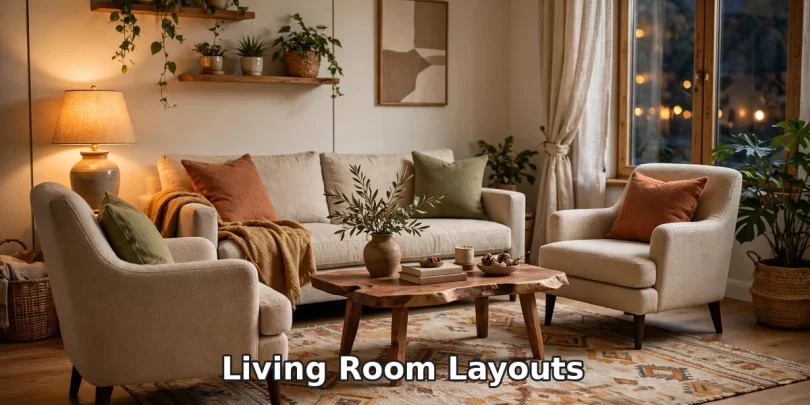
The honest test is distance, since people talk easily across roughly a metre and a half of shared space and start performing beyond two metres, so pull the seats in until knees nearly meet around the coffee table. Angle the armchairs rather than lining them up like soldiers, because angled seats invite the eye and the body both, and a slight turn feels like listening in a way that a straight row never will.
Give the group a centre it can believe in, a coffee table or a pair of small tables that every seat can reach without a stretch and a lunge. A table nobody can reach is a sculpture, and sculptures in the middle of conversations are how drinks end up on the floor and books end up under sofas. Keep the centre low, keep it clear enough for a tray and a game, and the seating group will start behaving like the heart of the home, which is the whole point of living room furniture layout ideas worth the name.
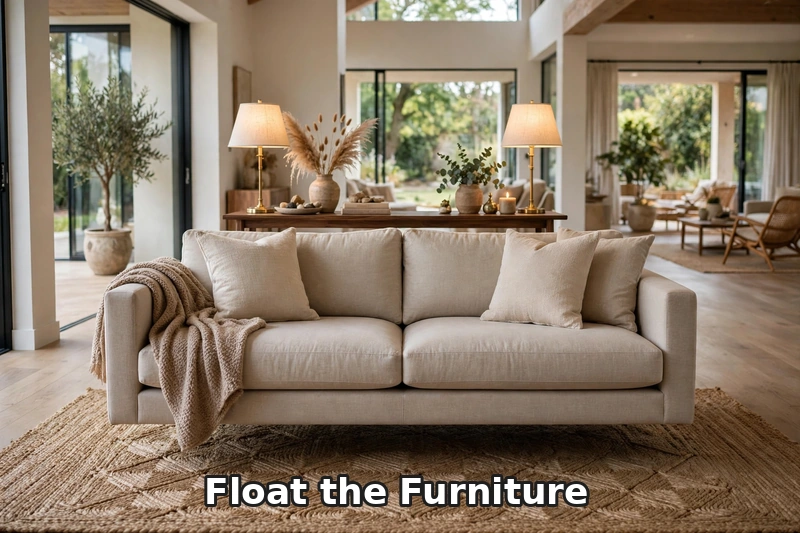
Float the Furniture Away From the Walls
The most common layout mistake in the world is the pushed-back room, every piece exiled to the walls like dancers avoiding the floor, with a great empty ocean of carpet in the middle that nobody uses and everybody crosses. Pull the sofa off the wall by even a hand’s width and the room changes its manners at once, because furniture that floats reads as chosen, while furniture that clings reads as stored. Designers call this floating, and it is the second great secret inside living room furniture layout ideas, powerful in large rooms and quietly miraculous in medium ones.
In a generous room, floating lets you build a true island: sofa and chairs on a rug in the middle, a narrow console behind the sofa carrying lamps and books, and the walls freed for the things that genuinely belong there, shelves, art and the television if it must. The space behind the sofa stops being wasted and becomes a shallow gallery or a reading strip, while the seating island becomes a room within the room, warm and self-contained. Guests settle faster in floated rooms, partly because the arrangement tells them exactly where the evening happens.
Small rooms can float a little too, even if it is only the armchairs angled in from the corners and the sofa lifted the width of a skirting board from the wall. The shadow gap behind furniture tricks the eye into seeing more room, and the slight angles break the box that small living rooms suffer from most. Try it for a week before you judge it, since floated furniture feels strange for a day and obvious forever after, a pattern every honest guide to living room furniture layout ideas will warn you about in advance.
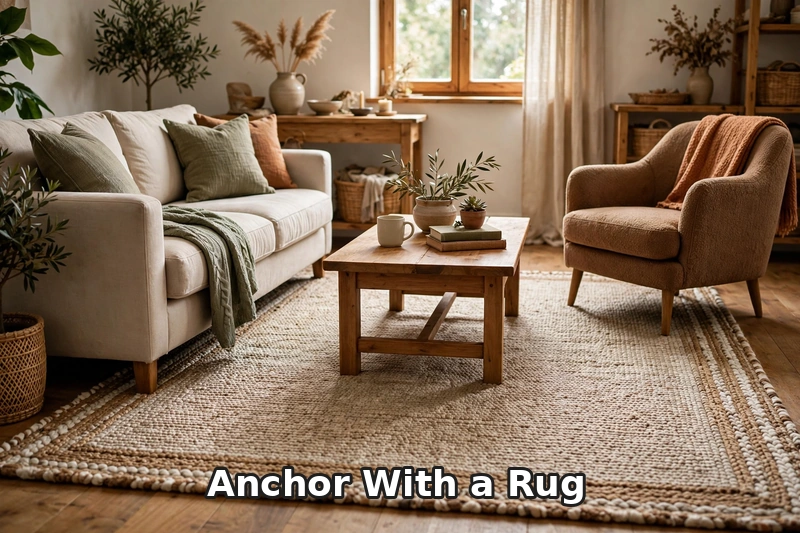
Anchor Everything on the Right Rug
A layout without a rug is a rumour, because the eye cannot tell where the room’s heart is meant to be, and the furniture drifts like boats that lost their moorings. The rug is the border of the conversation, and it should be big enough to hold at least the front legs of every seat in the group, so the arrangement reads as one island instead of several pieces sharing a shore. Too small is the classic error, a postage stamp under the coffee table that makes good furniture look lost and slightly comic, which is why rug size leads so many living room furniture layout ideas.
Lay the rug first and arrange on top of it, literally, standing on it to judge distances the way your guests’ feet will experience them. Front legs on, back legs off is the time-tested compromise when the perfect size is out of reach, and it works in nearly every room, while all legs on is the luxury version and no legs on is simply a mat under a table.
Keep Paths Clear and Corners Alive
A living room is also a road network, carrying people from door to kitchen, sofa to stairs, a dozen times an evening, and a layout that blocks its own roads will irritate everyone daily in small, sharp ways. Walk the routes before you settle the furniture, keeping a comfortable body’s width of clear path, and never make the main road pass between the sofa and the television, the single most argued-over crossing in family life. Paths are invisible when they work and unforgettable when they do not, so treat them as furniture in their own right when testing living room furniture layout ideas in your own space. Draw the roads first, and the living room furniture layout ideas will follow them.
Corners deserve a kinder fate than the dead zone they usually become, because a corner with a job pulls its weight in the room’s story. Leave one corner empty on purpose if the room is small, though, since a single breathing corner makes the rest of the arrangement feel generous rather than packed, a small mercy that living room furniture layout ideas for tight rooms rely on heavily.
Balance Big Pieces With Light Ones
Rooms feel wrong when the weight gathers in one place, the giant sofa, the dark bookcase and the heavy cabinet all holding hands along one wall while the other side floats away with a single chair. Spread the visual weight the way you would load a boat, the largest piece balanced by two lighter ones across from it, tall things answered by tall things, dark by a patch of light somewhere in reply. Stand in the doorway and squint, the oldest designer trick there is, and the room will confess its imbalances at once, long before you move anything heavy. Balance is the invisible half of living room furniture layout ideas.
Keep seat heights friendly with each other, let the coffee table sit lower than the seats, and if one piece is truly enormous, give it the room’s best wall and let everything else be its supporting cast. Harmony is not sameness, it is pieces that agree about the size of the world they live in, a quiet rule running under all durable living room furniture layout ideas.
Simple Layouts for Long, Square and Tiny Rooms
Long and Narrow Rooms
Divide a long room into two honest zones instead of stretching one arrangement along its whole length like a train carriage, a seating group at one end and a reading chair, desk or dining corner at the other. Splitting the room in two is the oldest of the living room furniture layout ideas for long spaces.
Square Rooms
Square rooms forgive almost everything except symmetry pushed too far, so arrange the seating in a friendly U or L and let one corner break ranks with a chair angled in or a plant standing tall. Centre the group on the fireplace, the window or the rug rather than the exact middle of the floor, because a group pushed slightly off-centre gains the cosy feeling of a nook while keeping the room’s balance. Off-centre grouping is one of the living room furniture layout ideas that square rooms reward most.
Truly Tiny Rooms
In a tiny room, choose one comfortable sofa over several tight chairs, keep every other piece light enough to move with one hand, and let the walls carry what the floor cannot: shelves, the television, the lamps. Two small side tables beat one grand coffee table, since they can part for dancing, guests or yoga, and a layout that can change its mind is worth more in a small home than any fixed arrangement, however pretty it photographs. Flexibility beats size in living room furniture layout ideas for tiny rooms.
You may also like these
9 Cosy Ways for How to Improve Home Insulation and Stop Paying to Heat the Sky
9 Joyful Easy Home Improvements for Beginners That Build Real Confidence Fast
9 Snug Steps for How to Seal Gaps Around Windows and Say Goodbye to Draughts
9 Delightful Small Bathroom Upgrades on a Budget That Feel Like a Hotel Treat
9 Easy Steps for How to Fix Cracks in Drywall and Make Walls Look New Again
Conclusion
Take an evening and treat your living room like a puzzle you are allowed to solve slowly, moving one piece at a time and sitting down after each move to feel what changed. Furniture is heavy but decisions are light, and you can reverse any of them before breakfast, which makes layout the bravest and safest experiment in the whole house.
Your living room does not need new furniture to feel new, it needs its pieces introduced to each other properly, close enough to talk, balanced enough to rest the eye, with clear roads running kindly between them. Do that with the things you already own and living room furniture layout ideas will stop being a search you repeat, and become the quiet reason your room is the one where every evening happily happens.
FAQs About Living Room Furniture Layout Ideas
How far should a sofa be from the coffee table?
Close enough that a seated person can set down a mug without leaning out of the cushions, roughly a forearm’s length from the edge of the seat to the table. Further than that and the table becomes scenery, nearer and knees argue with it all evening, and this small distance quietly decides whether living room furniture layout ideas succeed in daily life, not just in photographs.
Should all furniture touch the walls in a small living room?
No, and this surprises people, because even a few centimetres of shadow gap behind the sofa makes the room read larger, and angled chairs break the box feeling that walls create. Keep walkways honest and let the rug hold the group together, and a floated arrangement will feel generous rather than wasteful in all but the very tiniest rooms. Floating is the trick small rooms borrow from the best living room furniture layout ideas.
What size rug do I need under a seating group?
One large enough for at least the front legs of the sofa and chairs to stand on it, so the group reads as one island, and in most rooms that means bigger than your first instinct suggests. A small rug under only the coffee table is the most common layout mistake of all, which is why rug size appears in nearly every serious guide to living room furniture layout ideas.
How do I arrange a living room with the television as the focus?
Let the television join the conversation group instead of replacing it: sofa facing it, chairs angled in from the sides so people can turn between screen and company without moving furniture.
Can I mix two seating areas in one living room?
Yes, if the room is large or long, give each area its own rug and its own light, and let a console, a bookcase or the back of the sofa act as the border between them. Two clear zones feel like riches, while one blurred arrangement stretched across the whole room just feels unfinished, so divide kindly and light each half like you mean it. Two zones, two rugs, two lights is the recipe living room furniture layout ideas trust.